Thursday, 4 June 2015

Now the hype is gone: Modern Warfare 2 (Part 1)


I thought I may as well get an obligatory Call of Duty game out of the way for a review on its own terms now that the hype has faded. This will be done in two parts, one with Single Player and one with Multiplayer. Anyway, the series as a whole can range from universally praised, to a hated test of ‘MURICA!!', to ….an experiment that maybe now looks like it didn’t work. Some love it, some hate it, but its one of the few series to really be a mainstream hit with the masses.

I decided to go with Modern Warfare 2, mainly because it felt like the game that aimed the highest, being the direct sequel to the universally loved Call of Duty 4. It also had enough technical polish to make it stand out from most games at the time, before people started complaining that it was just more of the same every year. And lest we forget that it was by far the game with the most media attention, with the ‘No Russian’ mission setting a new watermark for violence in gaming.

But does it really deserve to be credited with being the ultimate multiplayer shooter by many fans? Does the story have more to it than one infamously controversial mission? What is IN here that keeps players coming back to this game instead of other titles in the series?

Also note, that THIS IS SPOILER TERRITORY! You have been warned, although it has been over 5 years now.

NOW WE'RE SPOILING!

Beginning with the single player, we need to see how the missions and story are structured. The game shares a lot with a few other of the latter half of Call of Duty titles in that the story can be boiled down to “America gets invaded and must fight back”. However, this can be done in a variety of ways. Black Ops II executed the story in such a way that you question whether the player’s actions are truly right, while fighting a groundroots movement with somewhat legitimate grievances. Ghosts meanwhile made it painfully apparent that America just got attacked by South America simply because the nations wanted to take over the place…not much context in game lads.

Modern Warfare 2 goes with a situation where the Russians get tricked into war by blaming an American soldier for a terrorist attack, and the game revolves around sorting out the conflict from that point on. This is not a bad setup, and ultimately there are twists and turns from the various characters you encounter. Makarov is an obvious bad guy, and the soldiers you are accompanied by are willing to do anything to complete the missions. The missions are played out either from the US Army Rangers perspective of defending against Russian forces in the east coast of the U.S, or from Task Force 141 as they covertly track down Makarov’s ultimate whereabouts.

Time to save the world

When this was released I enjoyed everything about the story, mainly for the intensity of the scenarios and striking impact, but after a playthrough this week, all I can think of the story is this: Awesome Silliness.  The first mission in Afghanistan is what to expect for a game styled as modern warfare, but the Cliffhanger mission sets the tone for the majority of the story once you get into a snowmobile escape chase. Its intense! The Hanz Zimmer score is pumping, you end up jumping over a gorge to complete the mission. Absolute silliness, and not exactly what you think of for a semblance of realism, but at that point you check the brain at the door for context and just go with it and enjoy all the Hollywood blockbuster style the missions provide.

As you play, you get a real sense of the production values and the star power of the story. The aforementioned Hanz Zimmer score is the best for any Call of Duty game, and really is what I remember most with hindsight. The missions simply wouldn’t be the same without it at times. The aesthetic design of the missions are more colourful than Call of Duty 4’s, with more emphasis on red for the American front and the 141 missions tend to veer more for the arctic conditions in Russian territory. The set pieces could still work well in today’s market (heck, ghosts DID reuse one for its intro) and you do still feel relatively in control. More recent CoD games tend to have the player lower their gun to indicate a scripted sequence of characters talking and such, so having none of that sorts gives the player a sense that they can shoot up the place at any time. The action peaks and valleys work superbly, with a tendency for one mission to be bombastic while another involves smaller skirmishes and specialty. This in particular is something MW3 got wrong with its campaign, too bombastic is a bad thing.

Perhaps its greatest asset is that behind the perfected technical standpoint lies a game where the creators actually had a passion to make this game.  Modern Warfare 2 and Battlefield 3 were sold as technical masterpieces for the genre, but it must be said that the little things MW2 features transcend it from being merely a technical showcase. The death screens have the usual features such as death by grenades, but did you know that there is one for getting blown up by a jet engine?


The game’s single player is filled with tidbits and easter eggs that makes it fun to play through. The Terminator’s Model 1887, the Aliens Heartbeat sensor, the James Bond esque escape on snowmobiles, the Wolverines! Mission, all are thrown in and more to enjoyable effect. Even at the end credits there is a photograph of the main cast looking set for a mission. The Museum epilogue is a great idea of showing the dev’s animations and art assets in an interactive way (and if you REALLY must, you can press the red button…if you dare)


And the impact of the set pieces is well done to complete things. Shepherds Betrayal, Escaping the Favela, Retaking the White House, the Final Speedboat chase. Even the Final Boss is enjoyable, despite being nothing but Quicktime events. Such highs are so good that it barely registers that Makarov’s presence really fizzles out at the end and you forget about him.

While there is a lot of praise to be said about the overall campaign, there are issues, especially when analysing through the lens of time. And this brings things to No Russian…

No retrospective review of MW2 is complete without an opinion on ‘No Russian’. Is it Encouraging terrorists? Is it just a shock for the sake of shock? Is it a chance for Infinity Ward to push the envelope of an interactive narrative in gaming? Well, In my opinion there is no doubt that while it’s the most well-known part of the campaign, it’s also the most gratuitous. Perhaps its not as gratuitous as MW3’s killing of a child, that felt very poor in taste for feeling that it was done for the sake of having controversy. Of course, we have something that definitely shocks. Everything feels very real, right down to the forced movement speed to show a deliberate side to Makarov’s spree. While you have the option of not killing until the FSB show up, it is very hard to act out such a role without firing at least a few shots in the air. And it’s not all that surprising that you get killed at the end of the mission, since acting this casually controversial in gaming is a good way to get negative karma. Your body is the plot point at the end of the day as well. Overall, this mission could have been skipped (heck, the game tells you you can!) and little would change if a cutscene replaced it.


On the other side of the coin, this does feel like a successor mission to drive the story, similar to Call of Duty 4’s Nuclear explosion. That game challenged the notion of player character immunity, and this feels like an attempt to show the horrors of this sort of violence in an all too familiar setting. While you can challenge MW3 for poor taste and non-existent context, this mission seems different, like its following through with its point. No Russian has enough context to justify its inclusion in the game, and the end scene does feel like a gutpunch for all the murdering you have committed.

And while No Russian is infamous, it is not the only part of the campaign that has issues. While it felt cutting edge for military shooters at the time, the story is very cliché at points and requires checking your brain at the door when viewed with today’s standards. Makarov starts out as a very hate-able villain, but his presence really downgrades as the story goes on in favour of Commander Shepherd. The blatant sequel bait is another issue that hurts the game, since Call of Duty 4 was very much self-contained. This sequel feels like it is missing the U.S counteroffensive in Russia, and a proper Makarov showdown, both of which get resolved in Modern Warfare 3. The graphics are still impressive and the more colourful aesthetic give it a better art style than its sequel, but it still has aged over time, especially after games like Advanced Warfare and Battlefield 3 have shown considerable advancements in facial features and the Frostbite engines capabilities respectively. The overarching story also feels looser than it should with some scenarios, with the oil rig mission in particular feeling like a mission that could have been removed from the game with minimal detriment to the story. Another issue with the story is some loose plot points. The player never really finds out how the V.I.P in the suburbs was killed by one of Makarov's Henchmen, or why just one A.C.S module was enough to disrupt the Eastern seaboard conveniently for an invasion.

Again, awesome silliness


That said, the campaign has held its own over time and is still an enjoyable thrill ride from beginning to end. The silliness had taken over from the relatively grounded CoD4, but not to the point of disrupting the tone of the story, like MW3. Its what the second instalment of a trilogy should be, an improvement in many ways over the original, adding its own flair, and expanding concepts. Sure, some don’t work, and its not going to be considered among the best military storylines but it does its job with brilliance nonetheless.


Join me in Part 2 when I cover the Multiplayer and Special Ops

Saturday, 30 May 2015

Hindsight: Burnout 3 Takedown

I can safely say that amongst the arcade racers out there the Burnout series is one of the most critically acclaimed and intense of them all. Boasting a fantastic sense of speed and excellent arcade handling physics, the series is excellent even for players who hate racing games but just want fun regardless.

While Burnout Paradise may be the high note Criterion has hung their hat on for the series, Burnout 3 is considered by many to be the best, myself included. But how does it hold up over ten years later and after the majority of arcade racers have lost out to the likes of Need for Speed(which the majority of Criterion staff have been merged with)? Is it still a classic now, or just another game with immense praise at the time which has lost its lustre?

For starters, I had to download a digital version for the Xbox 360. My copy for the original xbox had sadly scratched itself into oblivion, but another  €9.50 for the game seemed decent enough. The game immediately gets a bit of a downer look from me as the intro screen loads and it becomes apparent that Burnout 3 clearly hadn’t got HDTV’s or surround sound in mind when it was produced. Made before the seventh generation, it simply does not make as big an impression as the 360 edition of Burnout Revenge, which nearly gave you eargasms at maximum speed and had a lot more visual flair.

At least its not THIS bad

This was quite a surprise to me. The game when released looked pretty gorgeous at the time. The Renderware engine showcased brilliant destruction physics when a car crashed and the locations you raced on looked the part. Now though, it definitely feels subdued. That is not to say that the game is awful to look at, just that Revenge and Paradise really took things to the next level (and generation) while B3 seems like it really does stay in the original xbox and PS2 era.

A little touch that the xbox had which pits it above sticking MP3’s on a memory stick was the custom soundtrack. This was a necessity with B3 in particular, having fairly dated music. Most of the soundtrack is the pre-youtube era alternative rock with some notable exceptions such as the Ramones and Franz Ferdinand. Sadly the custom playlist feature is disabled on the 360 version, so you must either play the soundtrack in the dashboard before jumping in or get used to the year 2004 again…

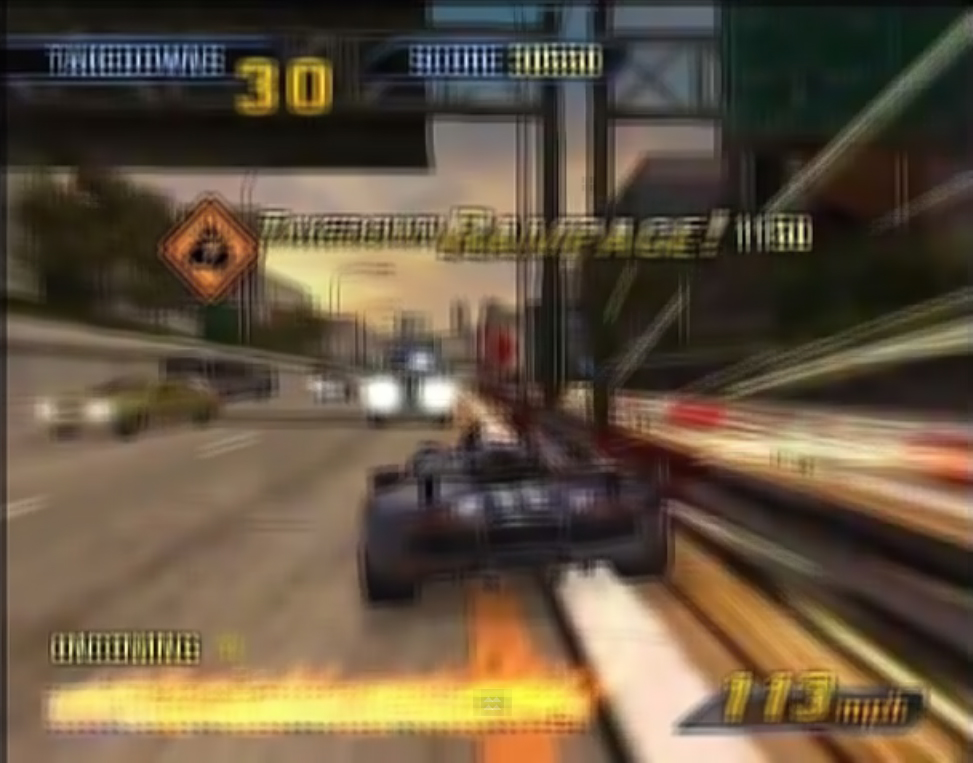
However, incredible radio music/announcer and mind blowing graphics are not what people remember from Burnout 3. They remember the pure fun factor of racing aggressively and making their opponents crash off a bridge and fly twenty feet in the air. Yes, the core gameplay is extremely simple to learn, exhilarating to play and a challenge for high scores, all in one. The driving controls are so slick that it’s hard to imagine ANY game in the future from beating this game bar another Criterion entry in the series. The sense of speed is amongs the best out there, despite being a little less flashy than the 360 version of Revenge.


Crucially, and this is my major gripe against Revenge, is that the game tone is centred around a lighter form of madness, as if this is made for those that are at a house party and want to play road rage while having a few beers. The music may be dated, but it’s still got an air of upbeat cheeriness while the thematic colour seems to be blue. Tracks are bright with blue skies and the menu screen has the blue overlay more in line with a GPS system. Revenge by contrast feels like it went overboard in making you hate your rivals, and the aggressive tone just was not to my taste.

Even the cars in Revenge were angry nasty work

While on the tracks, they are designed superbly for the game mechanics. Almost all corners cater to drifting around them instead of conventional cornering. Traffic hazards litter the courses, from buses and trucks to environmental ones such as bridge supports and clifftop routes. The pacing is great too. Silver Lake and Downtown are great introductions to general racing and road rage respectively. The Latter tracks in the far east are a true test of reflexes as you careen down the motorway, and readjust your brain to travel down the other side of the road. 

Finally, something that really gives B3 an edge on other fixed track games is that some routes connect a few tracks together (kings of the road for example connects all the American tracks together for one extra long rally track). This really gives a flee flowing seamless world feel to the tracks, and makes them feel like they all exist together rather than in isolated pockets with no connectivily (again, Revenge is guilty of this). The European highway route feels like a long drive and an enjoyable one at that, and it doesn’t hurt that you can throw your rivals into big rigs if that’s your thing.

The route from the peninsula to the Golden city is brill!


Events are well suited to the game, although by todays standards they may seem rather lean by comparison. You have your standard race and time attacks, but the best addition here is the road rage events. There is no need to win a race, nore beat a pre-set time. No, all you need to do is obliterate the opposition, and the more cars you wreck the higher the score. It’s a fantastic addition that really makes Burnout 3 stand out from the previous entries and paves the way for the future instalments. Nothing relieves road rage than, well…road rage.


And then there is the Crash Mode. While Revenge significantly upgraded this mode with custom tailored events, Burnout 3’s is nonetheless an entertaining addition (and it had to be, it takes up half the games events!).
The mode uses the same areas as the race tracks, but instead the aim is to destroy as much traffic at a junction as possible. The areas tend to have ramps and powerups as you try to beat the high score, and if done right, are a spectacular thing of destroyed beauty that must be seen to be believed.

This also showcases another mechanic new to Burnout 3, which is the aftertouch system. When you crash, there is an option to enter bullet time and slightly control the direction your wreck is hurtling. In race events this can be a minor addition while doing the usual slo-mo crash with unsettling ambient sounds, but in crash mode, it is a necessity if you want to get all gold in all the events.


Aside from the strategy involved in choosing the right angle of impact and the ensuing carnage, it isn’t what I remember most about the game, which is strange since it’s a mode that differs so much from its contemporaries. I do know some fans play this mode religiously though, so fear not, I still love this mode as a whole, but the racing is my favourite aspect.


So Burnout 3 then. As a whole, it’s presentation has aged a little, but the core mechanics still make this a masterpiece in gameplay, and a classic of the PS2 era. If you have never played a burnout game, this may be the best to start with, as it showcases so much of what makes the series fantastic. The crashes, the sense of speed, the fantastic driving mechanics, the reflex challenge of weaving through traffic at supersonic speeds. Pick this one up, your only regret will be seeing just how middle of the road arcade racers have become on the next generation since.

Tuesday, 12 May 2015

Welcome to the Game Defender blog!

Welcome to the site!
This blog is made for my opinions and commentary on gaming.

Some of the series I may create involve;

  • Game Defence-As the name suggests, I take a look at games that were released to middling reviews or disastrous commercial sales, and find out....Were they REALLY bad?!
  • Now that the hype is gone...-A look at games that were released with a fair amount of anticipation from the not too distant past, and find out how they stand on their own merits.
  • Hindsight-A look at games on previous generation consoles, most notably the Fifth and Sixth generation of consoles.
I hope you enjoy what I have to say on this blog, and take a look at the games I decide to take a look at.

Game Defence: Blur


Blur, a game that will be best known as Bizarre Creations financial disappointment and Activision's first major strike against the British developer before going for closure after 007 Blood Stone.

Bizarre's last racing title is an example of both how hard it is to succeed as a new IP and as a unique style of racing in a genre dominated with two serious simulation series (Forza & Gran Turismo) and an annual arcade powerhouse (Need for Speed).

The brand has managed to stay alive with Blur Overdrive, released in 2013 for mobile platforms, but lets take a look at one of the previous generations most underappreciated games.

Blur is a fantastic racing game, one that aims for a mature take on the kart racing genre a la Mario Kart and Crash Team Racing. Its got a style of its own however, with real world locations and Vehicles lighting up the game with neon glowing weapons and loose handling, set to the feel of exciting nighttime racing. It truly is light painting in game form!


Courtesy of Noctography

This is a racing game with a lot of style, so much so that the somewhat dated graphics don't matter at all when all of the weapons effects are flying on screen. The red smash of a shunt flipping a rival racer, the purple lightning bolts striking the front of the pack, or the pulsing mines scattered around the track all are examples of things that you just do not see in other contemporary racing games. This is the wipeout of our time, definitely made for a similar audience and with gorgeous effects and animations of weapon hits.


The racing mechanics themselves are very smooth and accessible, though the one thing that sticks out the most is that the drifting isn't quite what it should be. The burnout series for me still stands as the best example of sliding around corners as it feels you are going faster than following the line. Blur's drifting by comparison definitely has you not feeling as fast when sliding around corners, and it feels like something the developers wanted over conventional cornering so that's a shame. The sense of speed is excellent, especially noticeable when picking up the nitro speed boost power up. Three in a row makes you a speeding bullet barely able to notice the road ahead, and if you have memorised the route, you may not even care about it as you zoom past opposition.


Blur received criticism at the time of its release from some reviewers for not being the addictive, competitive online game that people wanted it to be, and not having enough defining moments. To those critics, I ask them to play the multiplayer mode, be it split screen or online, and return with compelling reasons for why it is not. Blur has constantly been in my xbox since I bought it, and while the online player base may be tiny, that it still runs so well, mostly lag free, and with most players in it to win it, the competitive element is strong.

Multiplayer is not just for the online crowd either. Its a sad fact that all too often games nowadays shun split screen for the online experience, but Blur handles split screen just as well as its online component. This is a feature made for nights in with friends over drinks and pizza. Get four controllers, a motor mash mode and watch sparks fly as your mates laugh at the fella that drove off the multi-storey car park!


Mario Kart for Adults

I may have criticized the graphics earlier for being dated, but they get the job done in regards for giving each location its own look. You obviously will see the difference between Route 66 and Tokyo, but the little details, such as Hackney's bus stops or roadsigns, and San Francisco's Tramlines and elevated roads, make for each tracks identity. The Geography of the locations come into things too. Mount Haruna is a drifters paradise, while Hackney has tight corners and not much room to breathe. Vehicles look the part, with a large selection of the sort of vehicles you expect from a street racer. Even the VW beetle gets a bit of love, and true to Bizarre Creations tradition, a Ford Focus is the starter vehicle for your first spin around Barcelona.


Brighton Beach, some spot for a race!

Sound is great, especially in game assets. The underside rumbles of your car are very convincing, as is the sound of the environmental hazards like the LA Dockside container ships or smashing of street signs. Weapon effects are the big standouts here though, each unique in their sound and appropriately jingle when used. The soundtrack is an eclectic mix for those who enjoy warehouse style raves in general and Crystal Method in particular, but if thats not your thing you can turn it off.

If you never played Blur when it first came out, its understandable given other racers were out at the same time, most notably Split/Second Velocity, and that you skipped over it. However, this is in my opinion just as good as Split/Second (a comparison will be done soon) and deserves a lot more love. Find a copy on Amazon or eBay, give Blur a chance, and if you have a few hours spare on a Saturday night, play with the few folks that still play this after five years online, and prepare to have a fantastic racing experience. You don't want to miss out on the enjoyment.